

Is bluegrass too fast for its own good?
Could the breakneck tempos at which bluegrass songs are commonly played be both a blessing and a curse?
(NOTE: there’s a poll question for you at the end—I’d love to know your thoughts!)
It’s a question that grows out of something we’ve explored before, which is the relationship between tempo and the brain.
As we’ve learned, your brain has preferred tempos for moving and for listening. There’s a pace you naturally gravitate toward when you’re walking, clapping, or tapping (your Spontaneous Motor Tempo, which we explored in this post).
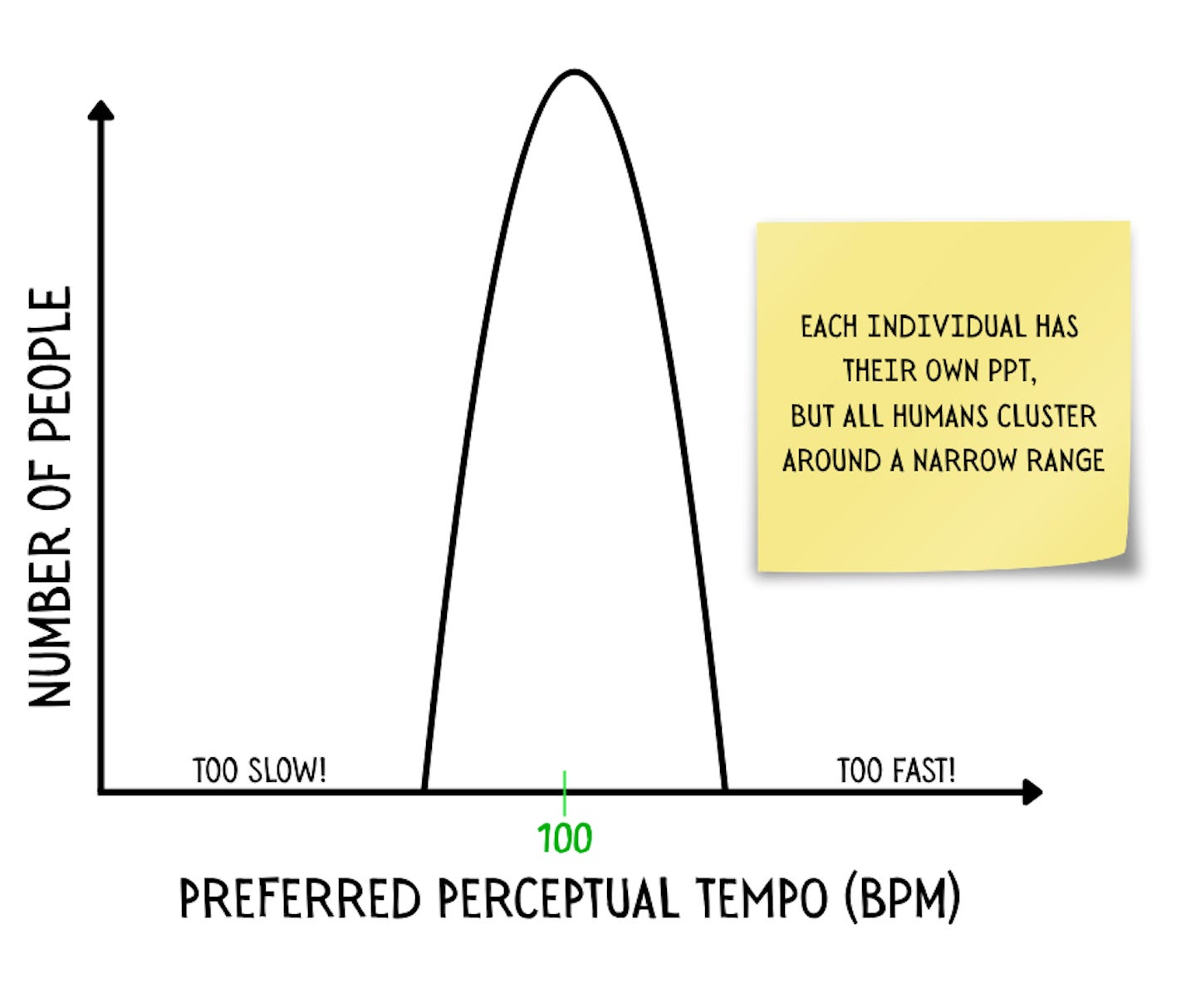
And there’s a pace your brain prefers for perceiving rhythmic sounds, which most of the time means music. Researchers call this your Preferred Perceptual Tempo, or PPT (more on that one here).
Each of us has our own PPT, but humans cluster narrowly around a particular value.
That tempo shows up in popular music. When researchers analyze the tempos of popular music, the most common tempo lands right around 100 bpm. That number matches almost exactly what PPT experiments predict.
That is no coincidence. Music is our way of vibrating air to tickle our perceptual circuits in all the right ways, and tempo is one of the ingredients we use to maximize the tickling.
There’s an infinite number of tempos we could make music, yet we’ve settled on a tiny sliver of that spectrum.
Because that’s what the brain likes.
Which brings us to the strange case of bluegrass.
The Outlier
Bluegrass was a genre dreamed up by Bill Monroe, which is why he’s called the “Father of Bluegrass.” He created the rules and expectations.
One of those expectations is around tempo. Take his Bluegrass Breakdown, a Greatest Hits compilation, as an illustrative example. The album has 12 songs, with tempos ranging from a low of 101 bpm (“Can You Hear Me Calling”) to a high of 163 (“Shady Grove”).
Here’s the full “breakdown”:
Can You Hear Me Calling—101
Blue Moon of Kentucky—105 (128 for the 4:4 speed up)
Footprints in the Snow—116
Nine Pound Hammer—118
Uncle pen—119
Prisoner’s Song—125
Muleskinner Blues—130
I Saw the Light—146
Shenandoah—153
Orange Blossom Special—157
Bluegrass Breakdown—162
Shady Grove—163
The average tempo across all 12? 135 bpms.
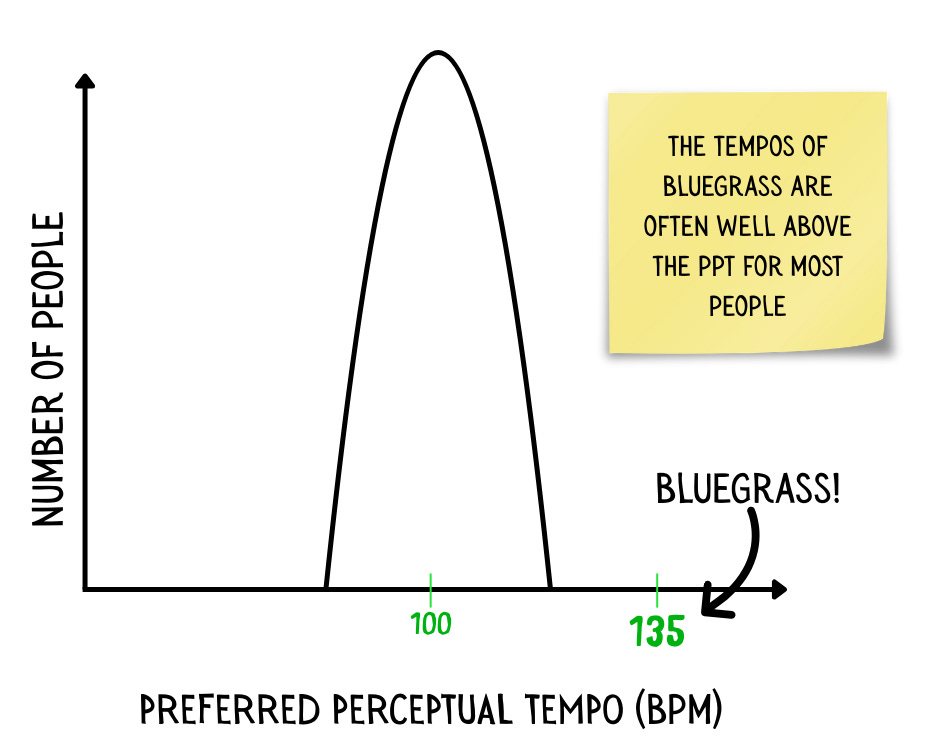
That’s way above the average person’s PPT for listening to music.
But…
If we look at the tempos of our most popular songs, we find the biggest spike averages around 100 bpm. However, there’s another smaller spike around 140 bpm.
What’s that about?
Dance music, that’s what!
When it comes to music that we enjoy for synchronizing our bodily gyrations to, we like things a bit peppier.
So while bluegrass tempos are well beyond what people prefer for listening, they’re squarely aligned with our preferred tempo for dancing.
Those of you who know the origins of bluegrass may see where this is going. Bluegrass began as Monroe’s attempt to commercialize the Southern mountain music he grew up with, and much of that music was for dancing—a fusion of dance music from Europe and African traditions into an American form.
Part of Monroe’s reformulation included adding instrumental solos. Solos added some variety to the listening experience and enhanced the live entertainment value.
But he didn’t change the tempos. In some cases, he sped them up.
Shady Grove: A Case Study
Here’s an example. This is the Appalachian folk song “Shady Grove.” It’s a song for singing, not for dancing.
It’s performed here by Jean Ritchie, who is singing and playing the mountain dulcimer. Ritchie was born in the Cumberland Mountains of Kentucky and learned hundreds of folk songs in the traditional way. Monroe grew up just a few counties over, so they likely shared the same musical heritage.
Her tempo? 100 bpm.
Now here’s Monroe’s rendition of the same song:
His version clocks in at a blistering 163 bpm.
He took a song normally played at listening tempos and cranked it up to the top end of dancing tempos.
Why did Monroe choose to do this? Why were faster tempos such a crucial feature?
I’m speculating, but I suspect it was partly to amp up the entertainment value for live performance. For Monroe, bluegrass was part musical experience and part spectacle (and in that era, which was not too far removed from the days of Vaudeville, it was common for musicians to also be entertainers).
Part of the entertainment value is marveling at technical abilities—people playing so many notes so fast. In the same way you’re entertained by a juggler or a tightrope walker.
For that to be impressive, the music needs to feel fast. You have to notice that the tempo is speedier than what you’re used to appreciate the technical feat.
That works well for live performance.
But it doesn’t translate to the listening experience.
And so you end up with tempos that are often much faster than what the typical brain likes. When we’re that far outside our perceptual comfort zone, the music becomes less intelligible. And listening starts to feel like work.
The Auctioneer Problem
Consider conversations. When we speak to each other, our brain has to analyze and decode the sound it receives. And there’s a pace that’s comfortable—speech that’s too slow or too fast requires extra effort.
Because we want to be understood, most of us talk at a pace that’s comfortable for our conversation partner’s brain.
When I was little, I loved going to the cattle auction with my grandfather becuase I loved listening to the auctioneer. I could barely understand a word he was saying, but that hardly mattered. I couldn’t get over how someone could talk so fast! I found it hugely entertaining.
For the average listener, bluegrass is like the auctioneer experience. Entertaining, even though you can’t fully understand it.
Now, brains are adaptable. With enough exposure, we can learn to parse music that’s outside our perceptual sweet spot. That’s the nature of an acquired taste.
Listen to the fast-talking auctioneer enough times and you’ll start to understand what he’s saying. Listen to bluegrass enough times and you’ll start to capture more of what’s happening.
But that requires patience and time. To acquire a taste—to build the necessary perceptual adaptations—you need a reason to persist.
The bitterness of coffee and beer is outside of a typical brain’s perceptual sweet spot. That’s why hardly anyone likes them at first sip.
But coffee and beer happen to come bundled with psychoactive substances—the caffeine and the alcohol keep you coming back. Over time, your brain adapts and voila: you enjoy not only the aftereffects but the taste, too!
Bluegrass has no such chemical hook.
The Consequences
Has this limited the popularity and growth of bluegrass? Almost certainly.
Consider bluegrass versus country. Both are recent splits from the same musical tree, but the difference in popularity is astronomical.
At this time, a top-10 country artist generates about 25 to 50 times the number of streams and touring revenue as a top-10 bluegrass musician (this does not include any band that happens to have a banjo or mandolin player, as Spotify would lead us to believe).
Consider also that Bill Monroe’s biggest hit—by a wide margin—was “Blue Moon of Kentucky.” Clocking in at a tempo of 105 bpm it was also one of his slowest songs.
I think this also explains the makeup of the bluegrass fan base. Fans of bluegrass are twice as likely to be musicians themselves (and play bluegrass, specifically).
Those who aren’t musicians tend to be rabid fans —i.e., a disproportionately passionate and devoted bunch. Bluegrass has a strong culture and community which has its own draw apart from the music.
In both cases, then, there are additional incentives at play that keep people listening long enough to acquire the taste.
The Chillgrass Project: An On-Ramp
I happen to love a lot of the traditional southern mountain music that bluegrass pulls from. And I especially love that it’s a tradition of music being made by “regular” people—a reminder that we were once all musicians.
Unfortunately, many equate mountain music with bluegrass. As in: that instrumental music with banjos and fiddles that people play really fast.
Not the best format for first impressions. Kind of like an auctioneer reciting Shakespeare. Too fast to appreciate the beauty underneath.
This has made it less accessible to both listeners and performers.
There’s no on-ramp for either group. It’s just sink or swim, and most people sink.
I’d like there to be many more on ramps. So that listeners can listen to versions they can relate to. So aspiring players don’t have to log 5,000 hours of practice before feeling any sense of accomplishment.
Plus, more players need permission not to chase a tempo target out of a sense of obligation—tempos that were designed to delight the eyes and not the ears. If that sounds like you, then you have my full permission to play at the speeds that sound best to you!
Providing more on-ramps for listeners and players was the idea behind the Chillgrass Project. What’s Chillgrass? It’s like bluegrass, but more chill.
Put another way: it’s traditional music played at tempos that more brains prefer for listening.
I have been wrist slapped for playing slow "sappy" songs at jams. My buds generally are all impressed (overly IMHO) with super fast pickers like Billy Strings, sometimes Bela Fleck etc. I lean toward the beautiful songs that are slower and often have roots in the Old World - Scotland, Ireland, England.
I appreciate your thoughts about this Josh. The issue of speed concerns me with other forms of music too. It may be jealousy, since I'll never be able to play that fast. But my rationale is this: I don't like music that draws my attention to the performer and takes it away from the music. I don't need to be impressed by speed. I want to hear a good song. It's a lot like acting. If I notice how well the actor or actress is acting he/she is not acting well enough.