

Hear the sound, then play the sound.
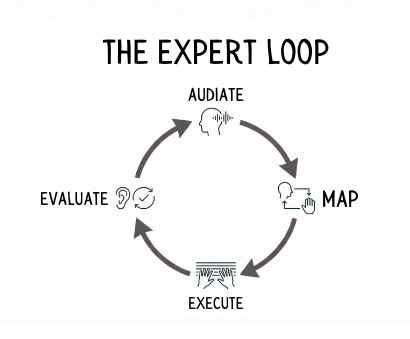
That’s the process research shows expert musicians use when playing music. More precisely:
Step 1: AUDIATE
Imagine the sound you want to make, or “audiate.” This step sets the goal.
Step 2: MAP
Transform that imagined sound into a motor program. Your brain must convert what you’re hearing internally into a sequence of hand movements.
Step 3: EXECUTE
Make the movements of your hands to generate the music.
Step 4: EVALUATE
Compare what you hear against what you intended. Notice any gap. Adjust.
Audiate, Map, Execute, Evaluate.
Then repeat—thousands of times, across years.
Notice what’s absent from this sequence: there’s no step that says “look at a screen or page to know what to play.”
The process begins and ends in sound.
The Invisible Architecture
To many people, an expert musician is simply someone with skilled hands—the ability to move quickly and precisely to play the right notes. But that’s not where expertise lives.
The expertise is in their musical cognition: the neural pathways they’ve built for mentally manipulating musical information.
One network for audiation. Another for mapping sound to movement. Another for evaluating what they’ve played against what they intended.
These networks are task-specific, deeply trained, and entirely invisible.
This invisibility is part of why musical expertise is so easy to misunderstand. When you watch an expert play, what you see are the hands.
What you don’t see is the cognitive architecture that’s directing them—the years of training that built pathways for hearing, imagining, and manipulating music mentally. The hands are just the visible output of a much deeper system.
The special sauce of expertise isn’t in the movements themselves. It’s in the plan that was crafted for moving them.
A plan that’s composed in the mind of the musician.
And the pathways that compose that plan weren’t just always there. They were built through practice. Which means you must practice in a way that develops them.
Where Practice Goes Wrong
This is where so many players go astray.
It’s entirely possible to spend years “practicing” without developing any of these skills. How? By bypassing the entire process.
When you learn a song purely from tab (or in any other written notation), the sequence becomes: look at symbols, decode the instructions, move your hands.
You might learn the song, but you haven’t practiced audiation because you never had to imagine the sound first.
You haven’t practiced mapping because you went from visual symbols to movements, not from sound to movements.
You haven’t practiced evaluation because you were checking your hands against the page, not your ears against your intention.
The source of the music is the crucial difference. Does the music originate in your mind, or on the page?
When tab comes first, the entire cognitive sequence that builds musical cognition is bypassed. You never build the special sauce, and then wonder why you don’t have it.
This is why so many people practice diligently and then feel frustrated by their lack of progress. It has nothing to do with talent, and everything to do with training.
Every song you learn is an opportunity to practice all of these skills, but it’s not guaranteed.
In the recent workshop learning “Shady Grove”, we moved through exactly this process. We listened, we audiated, we mapped sound to movement, we evaluated and refined. No tab required—not because tab is forbidden, but because we didn’t need it.
The music was in our ears, then in our minds, then in our hands. That’s the sequence that builds the cognitive networks you need. We never left the realm of sound.
(RELATED: click here to check out that workshop and the 4-step process)
If you want to use tab, use it to support this process rather than replace it. Specifically, use it if needed to help complete Step 2, the mapping of the sound in your mind to the necessary movements of the hands. All of the other steps should stay the same.
If you find yourself staring at tab the entire time you’re playing, on the other hand, you’re not practicing music. You’re practicing symbol decoding.
(Note: One reason lead sheets are such a great visual aid is that they can’t replace the fluency-building process, they can only support it).
As a general rule: the more time you spend in the realm of sound, the faster you’ll progress.
The less time you spend looking at a page or screen, the more you’re building the cognitive skills that actually matter (as I mentioned, you’ll get the most out of the workshop if you only use your ears and never look at the video).
This doesn’t mean tab has no place. It means tab should serve the music in your mind and not as a substitute for it.
The music comes first. Always.
If you want to go deeper into the science of molding your musical mind, check out my book Anyone Can Play Music.

Thank you, kind of figured it AI.... Appreciate your time.. Thanks
You so eloquently said what I’ve been thinking and doing for twenty years!
So many instructors seem to focus on the tab and nothing on any form of ear training.
I see reading tab and notation as a ’left brain’ activity, while hearing is more ‘right brain’